IN WHICH POOH TRIES TO SAVE AN AFTERNOON IN A JAR, AND CHRISTOPHER ROBIN MAKES AN AFTERNOON PLACE
Christopher Robin was lying on the rug one afternoon, being so still that it looked as if he were practising being an Afternoon Place all by himself.
“What are you doing?” I asked.
“I’m keeping the afternoon,” said Christopher Robin. “If you move about too much, you use it up.”
Pooh, who was sitting nearby in the thoughtful way he has (which is to say he was thinking of honey), said, “If you want to keep an afternoon, you ought to save it.”
“Save it where?” asked Christopher Robin.
“In a jar,” said Pooh, as if this settled it.
Christopher Robin looked at me.
“Pooh once tried,” I said. “And it was on a gold-coloured afternoon by the stream.”
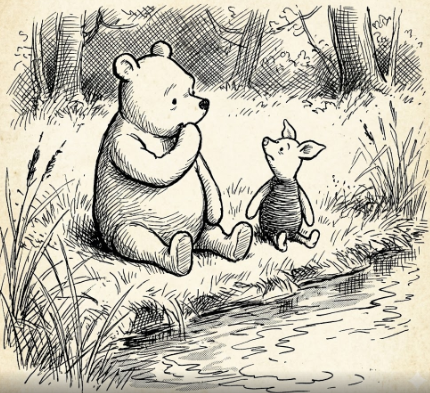
It was a sleepy, gold-coloured afternoon in the Hundred Acre Wood, the sort which makes you talk in quieter voices so as not to wake it. The sunshine lay in patches, and the shadows lay in patches, and down by the stream the water went on doing nothing in particular, and doing it beautifully.
Pooh and Piglet were sitting on the bank, with their legs in the long grass and their thoughts in the stream.
“Piglet,” said Pooh at last.
“Yes, Pooh?” squeaked Piglet.
“Do you ever feel,” said Pooh, “as if you have used up an afternoon?”
“Used it up?” said Piglet, staring at the sunshine.
“Like honey,” said Pooh. “I have been sitting, and thinking, and doing a little hum. And suddenly it came to me—what if I have used most of it up already, and later you want an afternoon, and there isn’t any left for you?”
Piglet’s ears drooped.
“Oh, Pooh,” he said.
“So we must save some,” said Pooh, standing up. “In a jar.”
“Have you got a jar?” he asked.
Piglet had a Very Small Pot which once had something in it and now only had the memory of it, but Piglet knew at once that Pooh was thinking of something bigger.
“I think,” said Piglet, “that I have only a small one.”
“Then we must use mine,” said Pooh. “I have a Very Good Jar at home. It has been used for Saving before.”
Piglet felt hopeful.
“What did you save in it?” he asked.
Pooh smiled the dreamy smile of a bear who has met honey.
“Honey,” he said.
So Pooh fetched his Very Good Jar from home. It had lately been full of honey, so Pooh made it Very Empty in the quickest way he knew, screwed on the lid importantly, and hurried back with Piglet before the afternoon could wander off.
Back by the stream, Pooh took off the lid and looked into the jar as if he expected to see the afternoon sitting at the bottom, waiting politely.
“It isn’t in yet,” said Piglet.
“No,” said Pooh. “We have to put it in. With the sunniest-looking things.”
Then Pooh said, “Saving works better if you have Rules,” because Pooh has always noticed that honey lasts longer if you decide it is not for eating all at once.
So Pooh made up some Rules, and because Piglet likes to know what is going to happen, he listened very carefully.
POOH’S RULES FOR SAVING AN AFTERNOON
- FIND A VERY GOOD JAR.
- PUT IN THE SUNNIEST-LOOKING THINGS FIRST.
- DO NOT FORGET THE QUIET.
- IF IT DOESN’T WANT TO BE SHUT, DO NOT ARGUE WITH IT.
So they began.
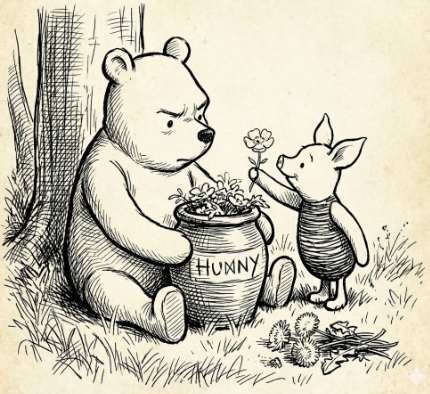
Buttercups and dandelions were everywhere, looking as if they had been practising being sunshine. Pooh filled the jar with buttercups first, then dandelions, while Piglet held it steady and tried to look as if he had saved afternoons before.
When the jar was half-full of yellow, Pooh stopped to hum, because yellow things always make Pooh remember how songs go.
Afternoon, Afternoon, golden and slow,
I should like to keep you, in case you should go.
Buttercups and dandelions, yellow as can be,
Leaf that says “Cheer up!”—come and sit with me.
If you won’t stay in a jar, then perhaps you’ll agree.
To stay on the grass, and be an Afternoon for three.
“That is a very good hum,” said Piglet.
“Yes,” said Pooh modestly. “It came from the yellow.”
Then Pooh found a leaf so yellow that it seemed to be saying “Cheer up!” all by itself. “Piglet,” he said, “this is an Extremely Encouraging yellow leaf,” and he put it on top where it could encourage everything properly.
“Now,” said Pooh, holding up the jar, “we have saved a good deal of afternoon.”
Piglet peered in.
It was very yellow. It was almost as yellow as the afternoon itself. But Pooh’s face still had that worried look, as if he could hear the afternoon ticking away somewhere behind the trees.
“It is not quite afternoon enough,” he said.
“Not enough?” squeaked Piglet. “But it is full of yellow.”
Pooh shook his head slowly.
“Afternoon is not only yellow,” said Pooh. “It is also a sort of Quiet.”
Piglet did not know how you put Quiet into a jar, but Pooh tried by adding more yellow.
He put in more buttercups. Then more dandelions. Then a few more, because the jar still did not feel afternoon enough to him. Soon it was so full that the Extremely Encouraging leaf had to sit on top like a hat.
“Now,” said Pooh, “I shall shut it very carefully.”
He pressed the lid down with both paws.
This time the lid almost caught, and the jar made a small squeak, and then—because dandelions are not the sort of thing to be shut up without making remarks — there was a sudden puff of white fluff.
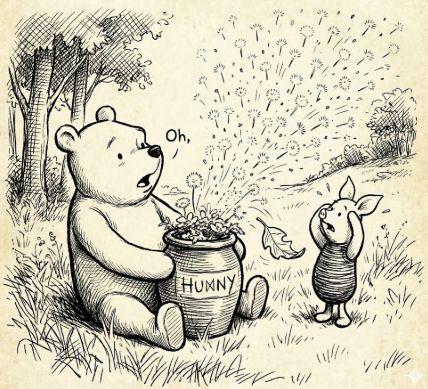
The dandelion seeds flew out and floated away on the air in a hundred tiny parachutes, drifting over the stream as if the afternoon itself had decided to leave in little pieces.
Piglet watched them go with a frightened squeak.
“Pooh,” he said, “the afternoon is escaping!”
Pooh stared at the floating seeds. His mouth fell open.
“Oh dear,” he said. “I have let it out.”
He sat down heavily with the jar between his paws, and for a moment he looked like a bear who has been trying to be helpful and has only succeeded in being sticky and wrong.
Just then Christopher Robin came along the path by the stream, as he often did on good afternoons, because he knew where good afternoons liked to be.
“Hallo,” he called.
“Hallo, Christopher Robin,” said Piglet quickly, because it is easier to be brave when someone taller is near.
Pooh looked up mournfully.
“Hallo,” he said. “We are Saving an afternoon, but it keeps getting out.”
Christopher Robin sat down beside them and looked at the jar and the yellow things and the dandelion seeds floating away.
“Tell me,” he said.
So Pooh told him, very carefully, how he had used up the afternoon by sitting, and how Piglet might have none later, and how you must save things in jars, and how the jar would not shut because it still did not feel afternoon enough, and then how the afternoon had escaped in little white pieces.
When he had finished, he looked at Christopher Robin as if Christopher Robin might know where you buy more afternoon.
Christopher Robin smiled a little, but not in a laughing way. It was a kind smile, as if he liked Pooh even when Pooh was being a Bear of Very Little Brain.
“Pooh,” he said, “afternoons don’t go into jars.”
Pooh’s ears drooped.
“Don’t they?” he asked.
“No,” said Christopher Robin. “Not really. You can’t keep them like honey. You can only have them.”
Pooh considered this. Piglet held his breath, because when Pooh considers, anything may happen.
“But,” said Pooh at last, “if you have an afternoon, and then you have it again, is it the same afternoon?”
Christopher Robin looked at the stream and the sunshine and the floating dandelion seeds, and he said, “It feels like it, doesn’t it?”
Pooh sighed.
“Yes,” he said. “And I should like Piglet to have it too.”
Piglet’s heart did a small warm thing, because Pooh had been worrying about Piglet all along.
“Then we will,” said Christopher Robin. “We’ll have it together. And I know how.”
He took the jar and carefully took out the buttercups and dandelions and the Extremely Encouraging leaf.
“We’ll make an Afternoon Place,” said Christopher Robin.
“An Afternoon Place,” repeated Pooh, pleased, because places are easier than jars and you can sit in them.
Christopher Robin laid the yellow things on the grass in a small bright patch, arranging them in a way which made you feel that the afternoon had been tidied up and put where it belonged. He put the Extremely Encouraging leaf in the middle, where it could do its encouraging properly.
“Now,” he said, sitting down beside the yellow, “we sit here, and we don’t do anything in particular.”
Piglet sat down at once, because “nothing in particular” sounded safe when Christopher Robin said it.
Pooh sat down too, very solemnly, because he did not want to waste any more afternoon by moving about.
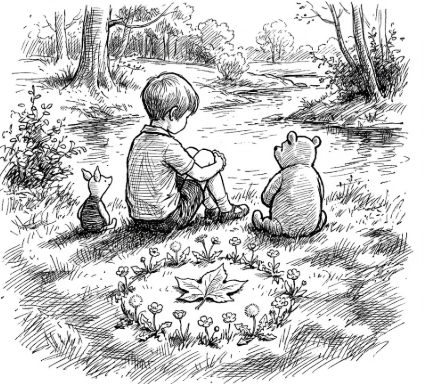
For a little while none of them spoke. The stream went on being a stream. The dandelion seeds went on floating until they found places to land. The sunshine went on lying in gold patches, and the shadows went on lying in shadow patches. And in the middle of it all, three friends sat in an Afternoon Place and had the afternoon without trying to keep it anywhere else.
After a bit Pooh gave a long satisfied sigh.
“Christopher Robin,” he said, “it feels full.”
Piglet nodded.
“It feels exactly full,” he whispered.
Pooh looked at the jar, which was now only an empty jar again.
“So I did not use it up,” he said.
“No,” said Christopher Robin. “You can’t use up an afternoon by sitting quietly in it. That’s what afternoons are for.”
Pooh thought about this and smiled.
“Then,” he said, “the best way to save an afternoon is to make a place for it, and have it.”
“That’s right,” said Christopher Robin.
Pooh began to hum very softly, not because he was doing something Very Important now, but because the afternoon was doing something Very Nice inside him.
And then Christopher Robin stood up and said, “Come on. It’s time for a little something.”
Pooh stood up at once.
“I thought you’d never ask,” he said, and Piglet picked up the Extremely Encouraging leaf and carried it for a little way, because he thought it would be a pity to leave encouragement lying about.
They walked home together, and behind them the stream went on doing nothing in particular, and the gold-coloured afternoon went on being gold-coloured until it became a different colour, which is what afternoons do.
“And that was how Pooh saved it,” I said.
Christopher Robin leaned back against me and nodded.
“Let’s make an Afternoon Place tomorrow,” he said.
“We can,” I said. “And the day after, if the afternoon is willing.”